library(dplyr)
library(tibble)
library(stringr)
library(readr)
library(quanteda)
library(word2vec)
library(ggplot2)

source("R/inaugural-corpus.R")

within_tolerance <- function(observed, expected, tolerance = 1e-4) {
  abs(observed - expected) < tolerance
}

metadata <- read_csv(
  "data/word2vec/word2vec-metadata.csv",
  na = character(),
  col_types = cols(
    field = col_character(),
    value = col_character()
  )
)
metadata_values <- setNames(metadata$value, metadata$field)

paragraphs <- inaugural_paragraphs()
training_tokens <- tokens(
  paragraphs$paragraph,
  remove_punct = TRUE,
  remove_numbers = TRUE
) |>
  tokens_tolower()

model <- word2vec::read.word2vec("data/word2vec/inaugural-word2vec.bin")
embedding_matrix <- as.matrix(model)
punctuation_rows <- rownames(embedding_matrix)[grepl("[[:punct:]]", rownames(embedding_matrix))]

training_summary <- tibble(
  item = c(
    "training documents",
    "tokens after cleanup",
    "vocabulary rows",
    "dimensions",
    "punctuation rows",
    "unique word pairs"
  ),
  value = c(
    metadata_values[["training_documents"]],
    metadata_values[["training_tokens"]],
    metadata_values[["vocabulary_rows"]],
    metadata_values[["dimensions"]],
    metadata_values[["punctuation_rows"]],
    metadata_values[["unique_pairs"]]
  )
)

hyperparameter_table <- tibble(
  setting = c("algorithm", "dimensions", "window", "iterations", "minimum count", "threads"),
  value = metadata_values[c("algorithm", "dimensions", "window", "iterations", "minimum_count", "threads")]
)

model_fingerprint <- tibble(
  field = c("generator", "model SHA-256", "reproducibility note"),
  value = metadata_values[c("generator", "sha256_model", "reproducibility")]
)
Training word vectors
Examine whether word neighbours indicate meaningful similarity
similarity
word embeddings
inaugural addresses
Learn how models train distributed word representations from local context. Examine why neighbour lists from a small corpus can be misleading.
A curator wants to tag a speech archive without reading every paragraph. She asks which words have similar vectors to freedom, union, and peace in the collection.
A table of neighbours can appear meaningful. However, a word-vector model can return a nearest neighbour for any word it retains.
A distributed word representation is one numeric vector per word, learned from nearby words. This lesson loads one saved local model. It compares a clearly related pair with arbitrary pairs.
TipWhat you will learn
This lesson shows how to:
- read a saved word2vec skip-gram model with a fixed version
- examine the preprocessing and training settings stored with the model
- explain why the page loads a saved fitted model instead of training during rendering
- compare an expected related pair with random pairs
- summarize the full distribution of cosine similarities.
Load one saved word2vec model
Word2vec comes from work by Mikolov and colleagues on learning word vectors from nearby words. The skip-gram version uses the current word to predict nearby words within a specified window. The R package splits input on whitespace. Before training, convert text to lowercase. Remove punctuation and numbers.
| Item | Value |
|---|---|
| training documents | 1377 |
| tokens after cleanup | 134419 |
| vocabulary rows | 2709 |
| dimensions | 50 |
| punctuation rows | 1 |
| unique word pairs | 3667986 |
| Setting | Value |
|---|---|
| algorithm | skip-gram |
| dimensions | 50 |
| window | 5 |
| iterations | 5 |
| minimum count | 5 |
| threads | 1 |
| Field | Value |
|---|---|
| generator | data-raw/build-word2vec-model.R |
| model SHA-256 | b182100ecb33cb339f16fdf5df5cea783dd113843a3a89e7e65393b921e448dd |
| reproducibility note | word2vec is not bitwise reproducible on this package version. Across five fits with the same seed the neighbour order changed every time, so this model is trained once here and committed. |
The metadata records 1,377 training documents, 134,419 cleaned tokens, 2,709 vocabulary rows, and 3,667,986 unique word pairs. It also records one punctuation row, the trainer’s </s> marker. Preprocessing removed punctuation before training, so forms such as peace. and peace, do not become separate entries from peace.
Repeated fits used the same training code, seed, and threads = 1L. Each fit produced neighbour lists in a different order. Similarity values changed by about 0.03 here, but the ranking changed. This page loads one saved fit. The metadata records its SHA-256 fingerprint, which identifies the file contents. Keeping a fixed model file lets readers reproduce the exact printed neighbours.
Print and assess neighbours
A nearest-neighbour list returns the words with highest cosine similarity to a query word. Cosine similarity compares vector direction. Larger values mean closer under the trained representation.
nearest_words <- function(word, n = 6L) {
  predict(model, newdata = word, type = "nearest", top_n = n)[[1]] |>
    as_tibble() |>
    mutate(
      similarity_band = case_when(
        similarity >= 0.8 ~ "0.80 or higher",
        similarity >= 0.7 ~ "0.70 to 0.79",
        TRUE ~ "below 0.70"
      )
    )
}

neighbour_table <- bind_rows(
  nearest_words("union") |>
    mutate(query = "union"),
  nearest_words("freedom") |>
    mutate(query = "freedom"),
  nearest_words("peace") |>
    mutate(query = "peace")
) |>
  select(query, neighbour = term2, similarity, similarity_band, rank)

expected_neighbours <- c(
  "texas", "attachment", "system", "jurisdiction", "confederation", "communities",
  "human", "evil", "mankind", "dignity", "civilization", "ancient",
  "friendship", "lasting", "world", "cultivate", "amity", "prosperity"
)| Query | Nearest word | Cosine similarity | Cosine similarity band | Rank |
|---|---|---|---|---|
| union | texas | 0.921 | 0.80 or higher | 1 |
| union | attachment | 0.919 | 0.80 or higher | 2 |
| union | system | 0.919 | 0.80 or higher | 3 |
| union | jurisdiction | 0.918 | 0.80 or higher | 4 |
| union | confederation | 0.914 | 0.80 or higher | 5 |
| union | communities | 0.914 | 0.80 or higher | 6 |
| freedom | human | 0.918 | 0.80 or higher | 1 |
| freedom | evil | 0.914 | 0.80 or higher | 2 |
| freedom | mankind | 0.908 | 0.80 or higher | 3 |
| freedom | dignity | 0.895 | 0.80 or higher | 4 |
| freedom | civilization | 0.894 | 0.80 or higher | 5 |
| freedom | ancient | 0.893 | 0.80 or higher | 6 |
| peace | friendship | 0.896 | 0.80 or higher | 1 |
| peace | lasting | 0.886 | 0.80 or higher | 2 |
| peace | world | 0.883 | 0.80 or higher | 3 |
| peace | cultivate | 0.881 | 0.80 or higher | 4 |
| peace | amity | 0.865 | 0.80 or higher | 5 |
| peace | prosperity | 0.863 | 0.80 or higher | 6 |
Some neighbours look plausible, but a neighbour list always returns results. Readable labels can make weak similarity evidence seem convincing. Keeping a fixed file makes the printed words reproducible. It does not show that the small model consistently gives related words higher scores than unrelated words.
Show the similarity distribution
The distribution below uses every unique word pair in the cleaned vocabulary. It also marks the freedom / liberty pair with a vertical line.
normalized_embeddings <- embedding_matrix / sqrt(rowSums(embedding_matrix^2))
word_similarity_matrix <- tcrossprod(normalized_embeddings)
diag(word_similarity_matrix) <- NA_real_
word_similarities <- word_similarity_matrix[upper.tri(word_similarity_matrix)]
freedom_liberty_percentile <- mean(word_similarities <= freedom_liberty_cosine)

similarity_summary <- tibble(
  statistic = c("word pairs", "median", "95th percentile", "freedom / liberty percentile"),
  value = c(
    length(word_similarities),
    median(word_similarities),
    as.numeric(quantile(word_similarities, 0.95)),
    freedom_liberty_percentile
  )
)| Statistic | Value |
|---|---|
| word pairs | 3667986 |
| median | 0.794 |
| 95th percentile | 0.935 |
| freedom / liberty percentile | 0.444 |
freedom / liberty is at the 44th percentile of the full pairwise distribution in this saved model. The clearly related pair has a score below the median for all pairs.
Show the plotting code
source("R/lesson-figures.R")

plot_similarities <- tibble(cosine_similarity = word_similarities)

ggplot(plot_similarities, aes(x = cosine_similarity)) +
  geom_histogram(
    bins = 40,
    boundary = 0,
    fill = lesson_colours[["context"]],
    colour = lesson_colours[["paper"]]
  ) +
  geom_vline(
    xintercept = freedom_liberty_cosine,
    linewidth = 0.9,
    linetype = "22",
    colour = lesson_colours[["contrast"]]
  ) +
  annotate(
    "text",
    x = freedom_liberty_cosine,
    y = Inf,
    label = sprintf("freedom / liberty\n%.2f", freedom_liberty_cosine),
    hjust = 1.08,
    vjust = 1.4,
    lineheight = 0.95,
    family = lesson_font,
    size = 3.6,
    colour = lesson_text_colours[["contrast"]]
  ) +
  scale_y_continuous(labels = scales::label_comma()) +
  labs(
    title = "Many arbitrary word pairs score above a clearly related pair",
    subtitle = "Cosine similarity for every pair of words kept by the pinned word2vec model",
    x = "Cosine similarity",
    y = "Word pairs"
  ) +
  theme_lesson(grid = "y")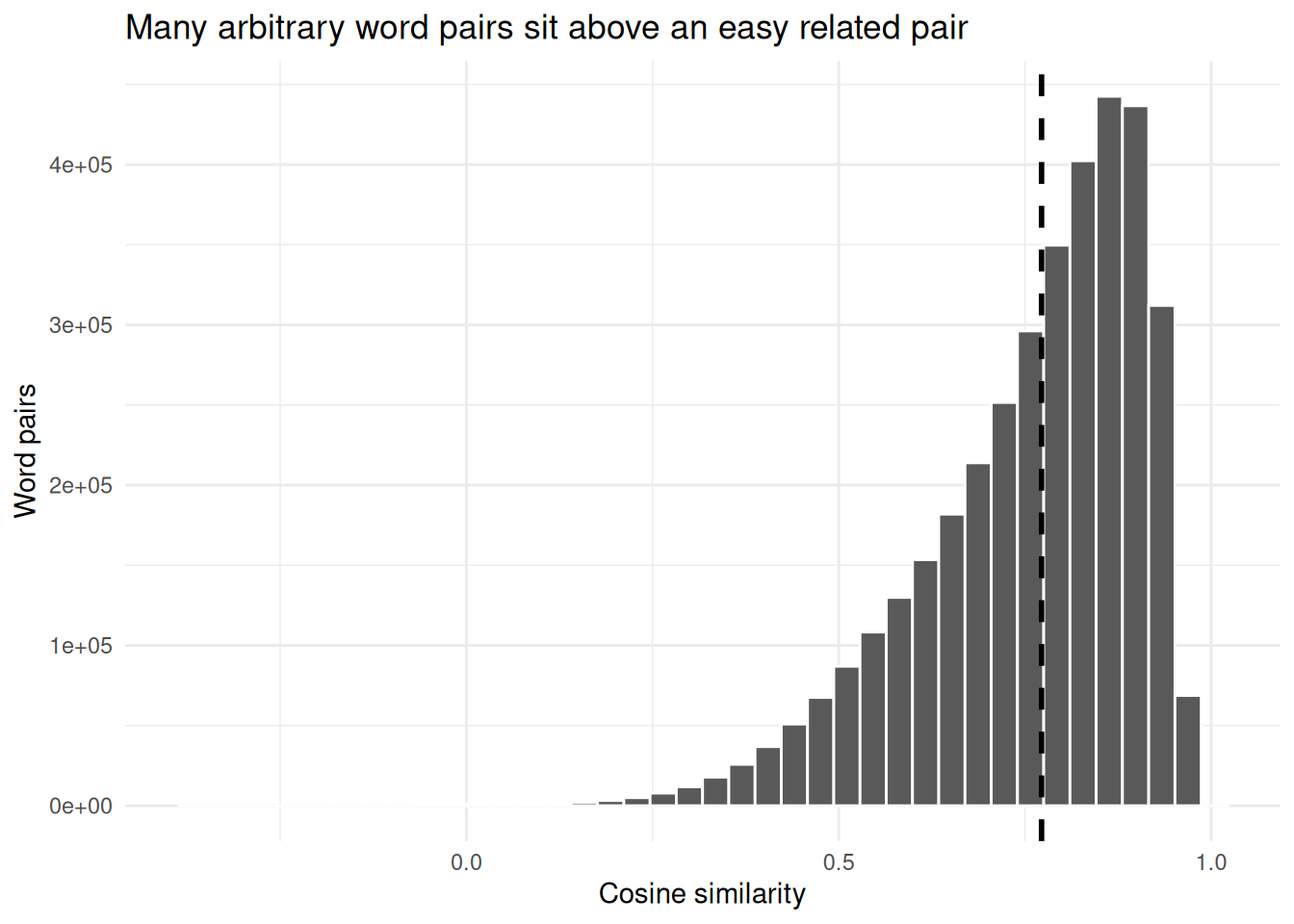
Published embeddings use billions of training tokens. A larger training corpus provides more contexts for distinguishing meaningful neighbours from accidental neighbours.
What to remember
- A word2vec model gives one vector to each kept word.
- The pinned model used skip-gram, 50 dimensions, window 5, 5 iterations, minimum count 5, and one thread.
- The word2vec package expects cleaned text before splitting on whitespace.
- Reproducing exact neighbour lists requires a fixed model file.
- In this saved fit, even
freedom / libertyscores below the median of all pairwise similarities.
The curator uses the neighbour table to select passages for reading. The table does not establish the archive’s themes.